How to chase a late invoice without losing the customer - a UK trades guide
How to chase a late invoice without losing the customer
Chase on the day it falls due, keep the first message friendly, and climb one rung at a time. Most late payments are not disputes, they are invoices someone forgot. The law gives you interest and recovery costs on top, but only when your customer is a business.
A January 2026 survey of UK tradespeople by Direct Line found 68% chasing at least one overdue invoice, and almost a quarter juggling four or more at a time (reported by Credit Connect). The government's own research puts the money owed to UK businesses in late payments at £26 billion at any moment, about £17,000 per business affected (Department for Business and Trade and Office of the Small Business Commissioner, July 2025).
Neither figure is the interesting one. The interesting one is how many of those invoices are never chased at all, because chasing is an evening job and the evening already has a job.
Chase early, and chase small
Most late payments are not disputes. They are invoices sitting in someone's inbox behind forty other emails, or a bill propped behind the kettle that got moved when the kettle got moved.
The single thing that changes the outcome is when you make contact, not how firmly. A polite nudge on day one of being overdue collects more money than a stern letter on day thirty, and it costs you nothing with the customer. Leave it a month and two things have happened: the job is no longer fresh in their mind, and you now sound annoyed, because you are.
So chase on the day it becomes late. Not the week after.
The ladder
Work up in steps. Each rung is firmer than the last, and you only climb when the one below it gets no answer. Most invoices never get past rung two.
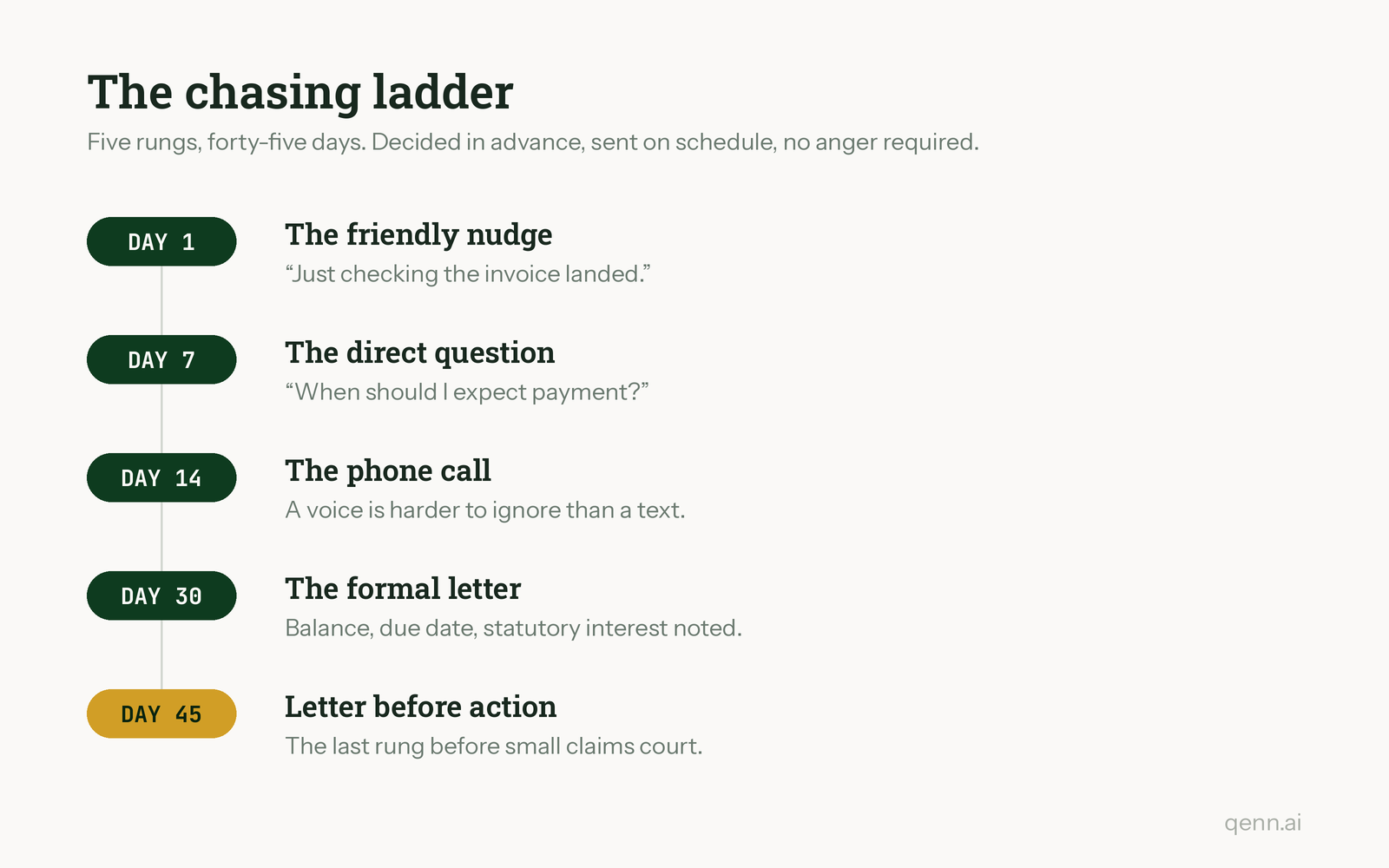
Day 1 overdue: a friendly nudge
Short, no accusation, assume it was missed.
"Morning John, invoice 118 for the bathroom was due yesterday - think it might have got buried. Here it is again."
Day 7: ask a direct question
Same tone, more specific. Restate the amount and the date, then ask something. A question is harder to leave unanswered than a statement.
"Is there anything holding it up at your end?"
Day 14: pick up the phone
This is the rung people skip, and it is the one that works. A call gets a real answer, usually either "sorry, doing it now" or a problem you did not know about.
Day 30: put it in writing
State the invoice number, the amount, the original due date, and what you will do next and when. If your customer is a business, this is where interest and recovery costs come in.
Day 45 or later: letter before action
Then the small claims track if it comes to it. Claims under £10,000 go through small claims, you do not need a solicitor, and the fee is recoverable if you win.
Where the law helps, and where it does not
This is the part almost every guide online gets wrong, so it is worth being precise.
The Late Payment of Commercial Debts (Interest) Act 1998 lets you charge statutory interest and a fixed recovery cost on late payments. It is a genuinely useful piece of law. It applies only where both you and your customer are acting in the course of a business.
So it covers you when you invoice a main contractor, a letting agent, a property management firm, a shop, a landlord operating as a business. It does not cover Mrs Patel whose boiler you replaced.
That distinction decides everything about which rung five looks like, so work out which one you are in before you write anything that mentions interest.
If your customer is a business
Two things you can add, on top of the debt itself.
Statutory interest: 8% above the Bank of England base rate. The rate is fixed by the base rate on 30 June or 31 December, whichever came before the debt fell overdue, and it does not move afterwards even if the base rate does. The base rate was 3.75% on 30 June 2026, so for any commercial debt that becomes overdue between 1 July and 31 December 2026, the rate is 11.75%.
A fixed sum for recovery costs, charged once per late payment:
| Debt | Fixed sum |
| Up to £999.99 | £40 |
| £1,000 to £9,999.99 | £70 |
| £10,000 or more | £100 |
If chasing has cost you more than the fixed sum in real terms, you can claim reasonable costs beyond it.
On timing: if you did not agree a payment date, the debt is late 30 days after they received the invoice or you delivered the work, whichever is later. Agreed terms can be longer, but for business-to-business they must be fair to both sides. Sixty days is the usual outer limit for business-to-business terms today, and it is set to become a hard legal cap for large firms paying smaller suppliers.
You do not have to charge interest. Plenty of people mention the entitlement without applying it, which is often enough on its own. But mention it accurately or not at all.
If your customer is a household
You have no statutory interest to fall back on. What you have instead is your own terms, so they need to exist before the job, not after it.
Put payment terms on the quote, not just the invoice. Say when payment is due and what happens if it is not. A late payment charge in your terms is enforceable if it is a genuine reflection of your costs and the customer saw it before agreeing. A number plucked from the air is not.
Beyond that, the ladder is the same, and it ends in the same place: letter before action, then small claims.
The rules are about to change
Everything above is today's law. Parliament is currently working through the Small Business Protections Bill, the biggest rewrite of late payment rules in over 25 years. Once it takes effect, expected no earlier than 2027, large businesses paying smaller suppliers will not be able to set terms longer than 60 days, interest on overdue invoices will apply by default rather than by request, customers will get 60 days to dispute an invoice and no longer, and the Small Business Commissioner gains the power to fine repeat offenders. All of it governs business customers. If your late payers are homeowners, nothing changes, and the ladder above stays the tool that works. We have set out what the new law does and doesn't fix in the 60-day payment cap post.
Why it does not get done
None of the above is difficult. It is a handful of short messages sent on the right days.
The reason it does not happen is that the right day is always a working day, and on a working day you are on a roof. By the time the van is back the day is gone, and chasing money at half nine at night, when you are tired and slightly resentful about it, is how a friendly nudge turns into a stiff one.
That is the real cost of unchased invoices. Not the interest you did not charge. The money, sitting there, because the person whose job it was to send a two-line message at nine in the morning was up a ladder.
A firm with an office does not have this problem. Someone sends the reminder on day one, because sending it is their job and nine in the morning is a normal time for them to be at a desk.
The honest caveat
The trades figures at the top come from Direct Line business insurance's January 2026 survey of UK tradespeople; the coverage we have seen does not publish its sample size. The national figures are from research by London Economics for the Department for Business and Trade and the Office of the Small Business Commissioner, published 31 July 2025. Treat the survey as a fair picture of the trade rather than a precise measurement, which is how we treat it ourselves.
The legal position above is current as at 30 August 2026. Interest rates change every six months by design, and the base rate is reviewed again on 17 September 2026. This is general information, not legal advice. If a debt is large or the customer is disputing the work, take proper advice before rung five.
Related reading
- The 60-day payment cap: what it actually means for tradespeople
- Where all that admin time goes for UK trades (and how to get it back)
- Missed calls cost UK trades thousands a year - here's the maths and the fix
- How to quote a plumbing job - template and examples
- How to save 8 hours a week on trade admin
Qenn writes the reminder on the day the invoice falls due, in your words, and asks you before it sends anything. You do the job. Qenn does the rest: quotes, invoices, payment chasing. First month free.
Ready to get your time back?
Start your first month free. No login - you just text it on WhatsApp.